
Half-day or full-day game drive in the Maasai Mara? Do the full day. Here's the math and the timeline

Most guests who ask me this are leaning half day. The reasoning is always the same: "6am to 6pm in a car" sounds like an endurance event, and the shorter drive must be the cheaper one. Then we talk, they switch to the full day, and by the end of the trip nobody has told me they wished they'd done less. I answer this question on WhatsApp more than any other, so here is the whole argument in one place.
The park sells one ticket, and it doesn't care how long you stay
The Maasai Mara National Reserve has no half-day entry fee. The ticket is a day pass, valid from 6am to 6pm, and as of September 2026 it costs a non-resident adult $200 in high season (July to December) and $100 in low season (January to June). You pay that at the gate whether you're inside for two hours or twelve.
The full fee table, the 12-hour rule and what the gate actually takes are in the park fees post.
The vehicle is the only part that changes with the length of the drive, and it's priced per vehicle, not per person. Our full day in a private Land Cruiser is $300 in high season, a little less in low season, and a half day is $180 to $200. So for a couple in August, the "saving" on a half day is $100 to $120, against $400 of park fees they've paid either way.
| Two adults, high season | Half day | Full day |
|---|---|---|
| Park fees (2 x $200) | $400 | $400 |
| Private vehicle with guide | $180–200 | $300 |
| Hours inside the reserve | About 4 | About 12 |
| Total for the day | $580–600 | $700 |
| Cost per hour in the park | About $145 | About $58 |
Put six people in that vehicle and the full day costs about $18 a head more than the half day, against the $200 each you've already handed to the gate. The park fee is the expensive thing, and the half day wastes most of what you paid for it. I sell full-day drives, so discount my enthusiasm however you like; the fee argument holds whoever you book with. The full cost breakdown has every other line item.
The cats keep dawn-and-dusk hours, so the drive should too
Lions, leopards and cheetahs are most active in the first hour or two of light and again in the last hour before dark. In the middle of the day they're mostly lying under something. The odd part is what people do with that fact: they book a morning drive that leaves camp at 7 and is back for lunch, which cuts the best light short at one end and misses the evening peak entirely.
A proper full day starts at the gate when it opens at 6 and comes back around 6:30. You get both peaks, and you get the hours in between to position yourself for the second one instead of driving back to camp and out again.

One thing to check before you book anywhere: not every driver is willing to do a 6-to-6 day. It's a long shift, and plenty of guides and operators build their days around two short drives instead, which is their style and works for them. But if you want the full day, ask directly whether your driver will do 6am to 6pm, because "full day" on a lot of itineraries quietly means 8 to 4. Ours do the real thing.
Twelve hours lets your guide actually use the park
The reserve is roughly 1,500 square kilometres and the good bits are spread around the edges of it. The Mara River, with the hippo pools and the crossing points, is off in one corner. The Sand River runs along the Tanzanian border on another side. The plains around Sala's and the luggas (the dry, tree-lined streambeds) where the leopards hang out are a long way from each other and a long way from the gates.
On a half day, your guide has to keep one eye on the clock the whole time, because at some point he needs to be heading back. That means he works the area nearest the gate, which is the area every other half-day vehicle is also working. On a full day he can commit: drive to the river and stay there, or follow a radio call to the far side of the reserve, because he doesn't have to be anywhere by eleven. When guests ask me why their friends "saw more" on the same number of days, this is usually the reason.
What the twelve hours actually look like
It is not twelve hours of sitting in a moving car. On a typical day with us, it runs something like this:
- 6:00, through the gate. Warm layer on, because an open vehicle at dawn is cold. First light is when the cats are moving, so the first two hours are the busiest of the day.
- Around 9, picnic breakfast under a tree. Out of the car, stretch, eggs and fruit and a flask of tea.
- 10 to 12, a slower drive toward the river.
- Around 12, the ranger walk. A reserve ranger takes you on foot along the Mara River for about 45 minutes, past the hippo pools and the crocodiles, to the spots where the crossings happen.
- Around 1, packed lunch somewhere shaded. Another long stop.
- 2 to 4, the quiet stretch. Slow, warm, good for the camera and for a nap in the back seat.
- 4 onward, the second peak. Animals get up, the light goes gold, and the drive home is often the hour people talk about at dinner.
- 6:30, back at camp for a shower and dinner.
Add the toilet stops, which happen whenever anyone needs one, and the fact that you'll spend an hour parked watching a cheetah decide whether it's hungry, and the day is really six or seven hours of driving broken into short pieces. Nobody has ever come back and said the problem was too much time in the car. The complaint, when there is one, is that it's over.
Yes, the afternoon is slower. It's also when the cheetahs hunt
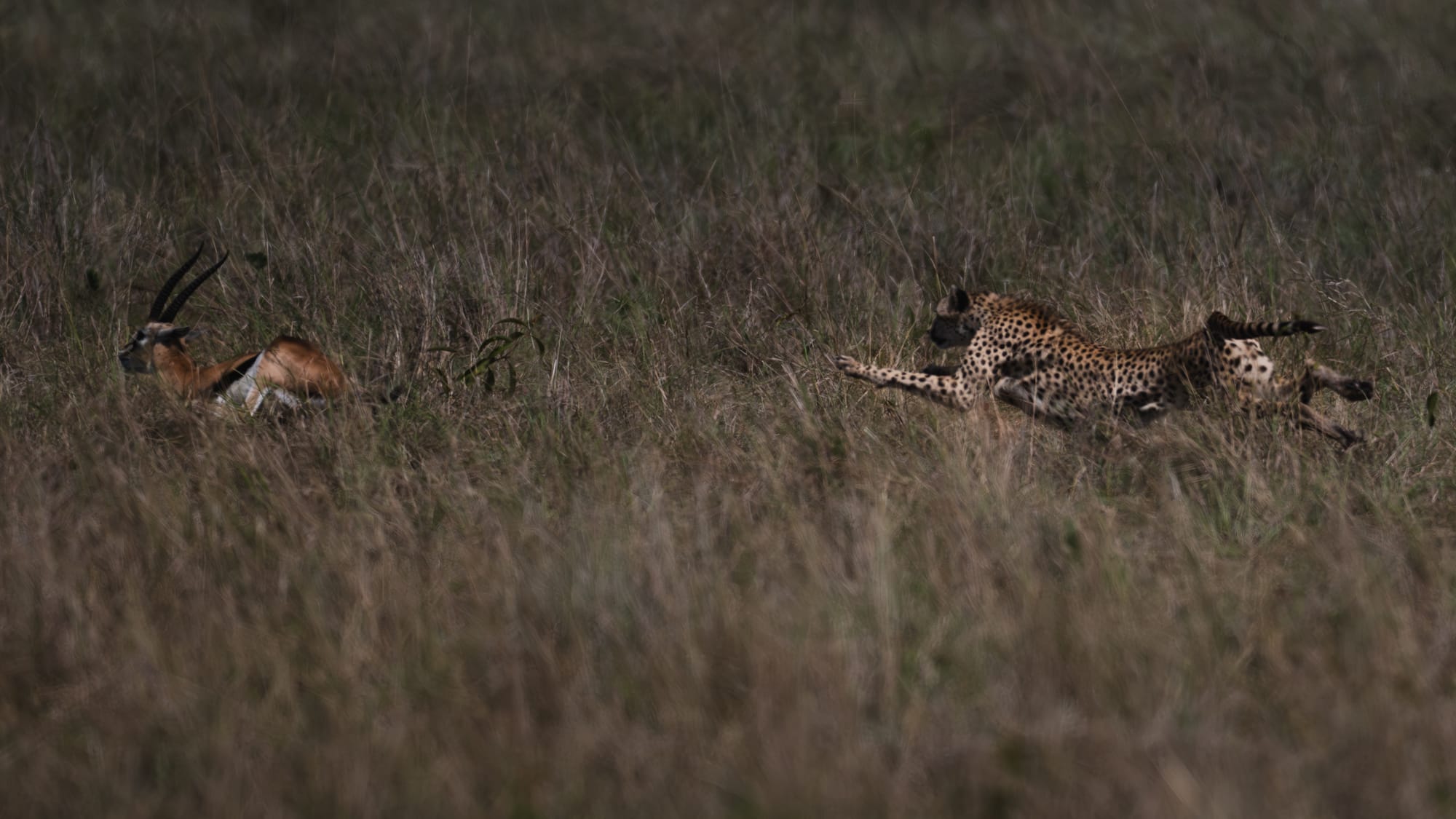
I won't pretend midday is as busy as dawn. It isn't. But "slow" in the Mara is a relative term. Cheetahs hunt in full daylight, when the lions and hyenas are asleep, and a hungry cheetah at two in the afternoon is one of the things I'd most want you to see here.
The river is the other afternoon show. Hippos spend the hot hours grunting and shoving each other in the pools, the crocodiles haul out onto the sandbanks, and in crossing season the wildebeest gather on the bank and dither for hours before one of them commits. If you're hoping to see a crossing, you need a full day for that reason alone, because they don't happen on a schedule and the half-day vehicles have usually left by the time the herd makes up its mind. I've written about what the migration is really like if you're coming for that.

The kids question
The most common version of the worry is "twelve hours is too long for my children." I understand it, and I've hosted enough families now to say it's mostly wrong. Kids do badly on a drive that is two hours of nothing, followed by a lodge, followed by another two hours of nothing. They do surprisingly well on a day that has a picnic in it, a walk along the river with a ranger, and lunch under a tree. The day has structure. There's always a next thing.
The genuine exceptions are children under about five, who can hit a wall in the afternoon heat, and any child who gets carsick, because the tracks are rough. For those families I'd still do the full day, but I'd tell the driver in the morning that you may want to head back after lunch, and if the kids are flagging, you do. A private vehicle means the day is yours to shorten. What you can't do is stretch a half day into a full one once you're out there and it's going well.
When a half day is the right call
I'm not going to pretend the answer is always the full day, because it isn't.
- The afternoon you arrive. If you get to the Mara at two, a 3-to-6 drive is the correct use of the daylight, and you'll still pay the full park fee, so go in.
- The morning you leave. Same logic in reverse.
- The third or fourth consecutive day. By then you've seen the far corners and a dawn-only drive with a late breakfast back at camp is a nice way to end.
- If you're staying inside the reserve. You're paying the park fee to sleep there anyway, so the fee argument disappears and two short drives from camp are fine. (Whether you should stay inside at all is a separate argument.)
If you have exactly one day in the park, or two, do full days.
Questions I get about the full day
What is the 12-hour rule in the Maasai Mara? The park ticket is valid from 6am to 6pm on the day you enter, and you can't carry it to the next day. A full-day game drive is designed to use the entire ticket; a half-day drive uses a third of it for the same money.
Can we come back early if we've had enough? Yes, if you're in a private vehicle. Tell the driver and you head back. It's rarely requested.
Is there a toilet? There are toilet stops along the way, and a bush and a vehicle to hide behind in between. It has never been a real problem.
What do we need to bring? A warm layer for the first two hours, a hat and sunscreen for the middle, a refillable bottle, binoculars if you own them, and a charged phone or camera. Picnic breakfast and lunch come with the vehicle. There's a longer packing list if you want it.
Is a full day worth it in low season? More so, if anything. The fee is half, the park is emptier, and a full day in the green season with nobody else at the sighting is as good as this place gets.
If you're still unsure, message me on WhatsApp and tell me who's coming and how many days you have. I'll give you a straight answer. It'll probably be "full day," but I'll explain why for your trip specifically, and I'll tell you if I think it isn't.
— NJ, Mara Hilltop

.jpg)