Can you self-drive the Maasai Mara? Yes, no, and the Mara Triangle rule nobody explains

Every couple of weeks, someone pulls into our lodge in a rented Land Cruiser with rooftop tents, a fridge in the back, and a phone full of contradictory research. They've read a Reddit thread telling them self-driving the Mara is a terrible idea, a travel blog saying it's not allowed anymore, a rental company insisting it's completely fine, and a forum post claiming private cars were banned last year. All of those are on the first page of Google right now. Three of them are right about a different half of the Mara, and none of them says which half.
Here's the actual answer, as of August 2026, from a lodge 2.5 km outside Sekenani Gate that gives this briefing to self-drivers over breakfast: yes, you can self-drive the Maasai Mara, but only in the Mara Triangle. The main reserve, the side you enter from Sekenani or Talek, is guided game drives only.
And the reason the internet cannot agree is that this is recent. Until mid-2024, you could drive your own car around the whole reserve.
What changed in June 2024
On 3 June 2024, Narok County's Chief Park Administrator issued a memo banning private vehicles from game drives in the Maasai Mara National Reserve. Only safari trucks, safari Land Cruisers and safari vans are allowed for game drives now. The directive implements the reserve's 2023–2032 management plan, approved in February 2023, and it landed a month before that year's migration crowds arrived.
So every blog post and YouTube video from 2023 or earlier showing someone happily self-driving past Sekenani was accurate when it was made. It has simply aged out, and nothing on the internet announces that it has aged out.
One reserve, two sets of rules
The Maasai Mara is one ecosystem but two administrations. The bulk of it, the eastern and central side where the main gates are (Sekenani, Talek, Oloolaimutia), is run by Narok County. The section across the Mara River, called the Mara Triangle, is managed by the Mara Conservancy, and it never banned self-driving. The rule splits exactly along that line:
| Main reserve (Narok side) | Mara Triangle (west) | |
|---|---|---|
| Self-drive / private vehicles | Banned for game drives since June 2024 | Allowed |
| How you do a game drive | Licensed safari vehicle with a guide | Your own 4x4, or guided |
| Entry fee (non-resident) | $100 Jan–Jun / $200 Jul–Dec per person per day | Per-person day ticket plus a separate vehicle fee (current rates) |
| Payment at the gate | USD/KES cash, card or M-Pesa | Strictly cashless: e-ticket online, or card / M-Pesa |
I sell guided game drives, so weigh my incentives however you like. The more useful bias: I like that self-driving exists here. Some of my favorite guests are the overlanders, and everything below is the same brief we give them.
Getting to the Triangle from Sekenani, step by step
Most self-drivers put the trip together themselves and come from Nairobi through Narok, which lands you at Sekenani on the eastern edge, a long way from the Triangle. You do not have to drive around the outside of the reserve to get there. There's a sanctioned shortcut through it:
1. Enter at Sekenani Gate and tell the rangers you're in transit to the Mara Triangle. 2. Ask for the transit permit. That's the phrase we send arriving self-drivers in with, and it lets you cross the main reserve without paying the Narok-side entry fee, because you're crossing, not game-driving. Stay on the main track and keep moving. 3. Cross to Purungat Bridge, where the Mara River marks the boundary and the Triangle begins. 4. Pay the Triangle's fees there. The Mara Conservancy's own site puts it plainly for its guests: "If you are staying in the Mara Triangle and are driving through Sekenani Gate on the Narok side, do not pay park fees until you enter the Reserve at Purungat Bridge." In our experience the desk treats day-trippers based outside the reserve the same way: say you're in transit, take the permit, pay at the bridge. Pay at the wrong desk and the money has gone to the wrong administration; nobody transfers it, and you'll pay again.
At the bridge itself, the Triangle is strictly cashless, so a wad of dollars won't help you: tickets go through KAPS, the payments contractor the Conservancy uses, bought online with a Visa card or at the gate by card or M-Pesa. Everyone in the car needs a passport or Kenyan ID to prove residency status when paying, and a driver's license is specifically not accepted, so keep passports reachable rather than buried under the fridge. Fees run per day. Person tickets and the 12-hour vehicle fee both run 6 am to 6 pm, no matter what time you drive in, and neither carries overnight. Within that window you can exit and re-enter as often as you like. The Triangle even mirrors the Sekenani arrangement in reverse: a vehicle just passing through it to somewhere else gets two hours of transit before fees apply.
What self-driving is actually like
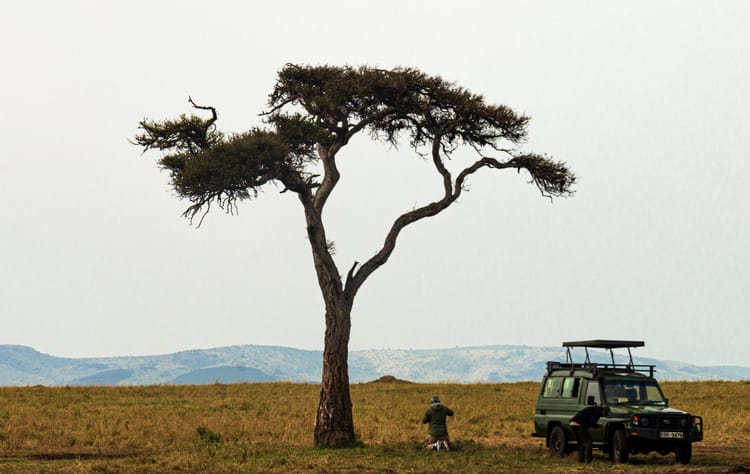
The rule says you can. Whether you should depends on what you're driving and when. You need a real 4x4, and this is not a formality: the Mara's black-cotton soil turns to grease after rain, and the tracks braid, fade and reappear in ways that make Google Maps a work of fiction. Dry season in a proper Land Cruiser or Hilux is very doable. Wet season in a small SUV, you will meet the mud, and the mud usually wins.
Navigation is the other half. There are no signposts out there, and "the track by the crossing point" is not a searchable address. Plenty of self-drivers do fine with offline maps and patience. But finding your way is not the same as finding animals, which is a skill that takes years to build.
Which is why we offer the thing I'd recommend even if we didn't sell it: you can take one of our Maasai guides along in your own vehicle for $80 a day. You keep the wheel and the rooftop tent; you gain someone who grew up on this land and reads grass and bird behavior the way you read road signs. It's optional. Self-navigating the Triangle with a decent map is a legitimate adventure, and some people are there for exactly that.

The better game viewing is usually on the side you can't drive
Depending on the season, there is often more wildlife action in the main reserve than in the Triangle, and the main reserve is the side you cannot self-drive. It's an annoying pairing, and pretending otherwise wouldn't help you plan.
So the play I suggest to overlanders: do the Triangle first, self-driven, and enjoy it properly. It's quieter than the main reserve, and nobody hurries you off a sighting. Then decide, based on what you saw and what the season is doing, whether to add a guided day in the main reserve. That's the order I'd do it in myself, because it means you buy the guided day only if you actually want what's over there. Plenty of guests skip it and leave happy. In crossing season, almost nobody does.
Since the ban, some self-drivers report rangers at Sekenani or Talek offering, and sometimes requiring, a gate guide who rides in your own car for roughly $50 to $80 a day. It happens, but it's gate discretion rather than a published rule, and I wouldn't build a trip plan on it.
Self-driver's checklist
- A real 4x4, not a tall 2WD in costume
- Passports or IDs reachable for everyone in the car; a driver's license won't work at the fee desk
- Transit permit at Sekenani Gate if you're crossing to the Triangle
- Card or M-Pesa for the Triangle; cash won't help you there
- Offline maps downloaded before you leave signal
- Full fuel and water; distances out there are honest
- The 6 am to 6 pm ticket window planned around, so you're not racing the clock at day's end
- Park basics: stay in the vehicle except at marked stopping points, stay on tracks, give animals right of way, and don't test any of this with elephants
Questions self-drivers actually ask us
Do I need to hire a guide for the Mara Triangle? No. Self-navigating is allowed and plenty of people do it with offline maps. The $80 ride-along changes what you find, not whether you're permitted to look.
Can I self-drive at night? No. Tickets run 6 am to 6 pm and the reserve doesn't do night driving at all. If you want the nocturnal stuff (we see everything from white-tailed mongooses to properly active lions), that's a guided night safari in a neighboring conservancy, not something any permit lets you do solo.
Do I pay a park fee on the day I arrive at my lodge? Not if your lodge is outside the reserve and you're not entering that day. Fees are charged per entry day only, which is a real argument for sleeping outside the gate between park days. I've broken down the full fee math in the safari cost post, and the inside-versus-outside question has its own article.
The whole fee system, Narok side and Triangle, is in Maasai Mara park fees in 2026.
Is the transit permit a trick to make me pay twice? The opposite. It exists so you can cross the main reserve to reach the Triangle without paying the Narok-side fee for a day you're not game-driving there. Ask for it plainly at Sekenani and keep to the main track while crossing.
The rules here changed once already, in June 2024, and they can change again, which is exactly how the internet ended up this confused. If you're reading this long after the date above, message us on WhatsApp and we'll tell you what's true this season.
— NJ, Mara Hilltop