I Kept Coming Back to the Maasai Mara for 15 Years. Then I Built a Place Where I Could Actually Stay.
I'm a software developer. I've spent the last decade building things on the internet (DeFi protocols, startup products, AI tools), mostly from my laptop, mostly from wherever I happened to be living at the time. California, Spain, Bali, Mumbai. The usual digital nomad rotation.
But the place that kept pulling me back was the Maasai Mara.
I should explain. I grew up in Tanzania, and my parents later moved to Kenya. Even after I left for university in the States and started my career in California, I kept coming back to Nairobi to visit family. And whenever I was home, our thing, the family outing, was a trip to the Mara. Once or twice a year, for about fifteen years. It was never a bucket-list safari for me. It was more like visiting a place that had always been part of my life.
But those trips were always short. Two or three days, the way everyone does it. You drive down from Nairobi, you go on game drives, you see lions, you take photos, you drive back. It's incredible every time. But it's also a glimpse. A trailer for something much longer.
The problem was, there was no way to stay longer. Everything in the Mara was built for that 2-3 day visit. The lodges we looked at charged $300, $500, $800 a night. There was no decent wifi, no workspace, no infrastructure for someone who might want to stick around for a couple of weeks. You came, you did your game drives, you went home. That was the deal.
But I kept having this itch. I wanted to know what the Mara looks like when you stop rushing through it.
The thing about slow travel that nobody tells you
When you stay somewhere for two weeks instead of two days, you start noticing things that tourists never see.
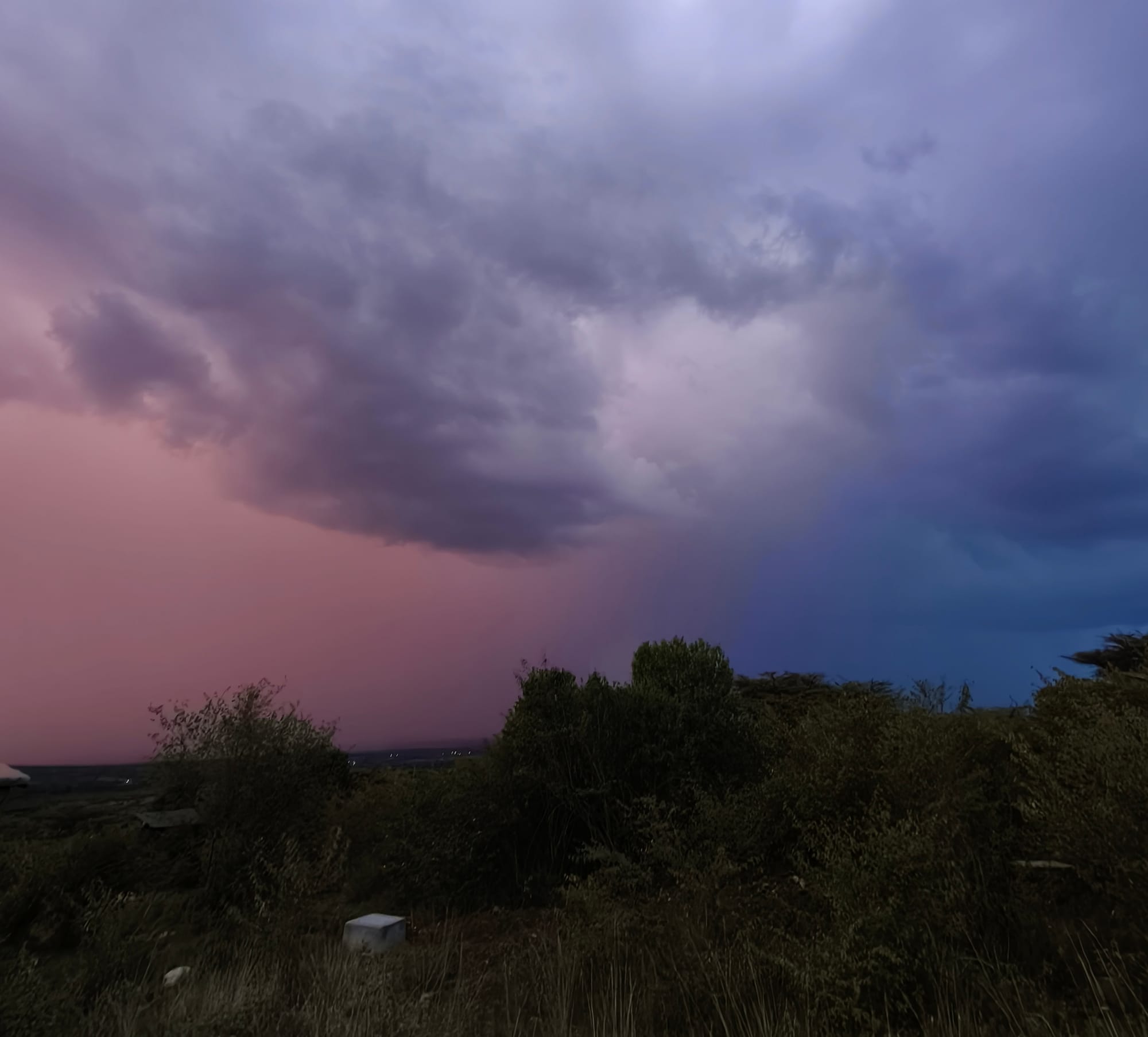
You notice the weather. I still don't fully understand the science of it, but from the top of our hill, you can watch storms roll in across the plains in real time. Sometimes there's a downpour on the right side and a golden sunset on the left, with this sharp, almost theatrical line between the two. It's the kind of thing that makes you put your laptop down and just stare for a while. I've traveled a fair bit (South America, Europe, Southeast Asia) and I've never seen weather dynamics like this anywhere else.
You notice the birds. Not in a "oh, there's a pretty bird" kind of way. In a "the soundtrack of your entire day changes depending on the time and the season" kind of way. You wake up to them. They go quiet during the hot part of the afternoon. And then in the evening, just before sunset, the whole thing starts up again.
And then there are the encounters you couldn't plan for.
I bought a motorcycle to get around once I started living out here. One evening, I was riding towards the Sekenani gate to pick something up. Nothing dramatic, just a normal errand. I saw a jackal on the side of the road, making a sound, clearly agitated about something. I stopped. The jackal was staring across the road, so I turned to see what it was looking at.
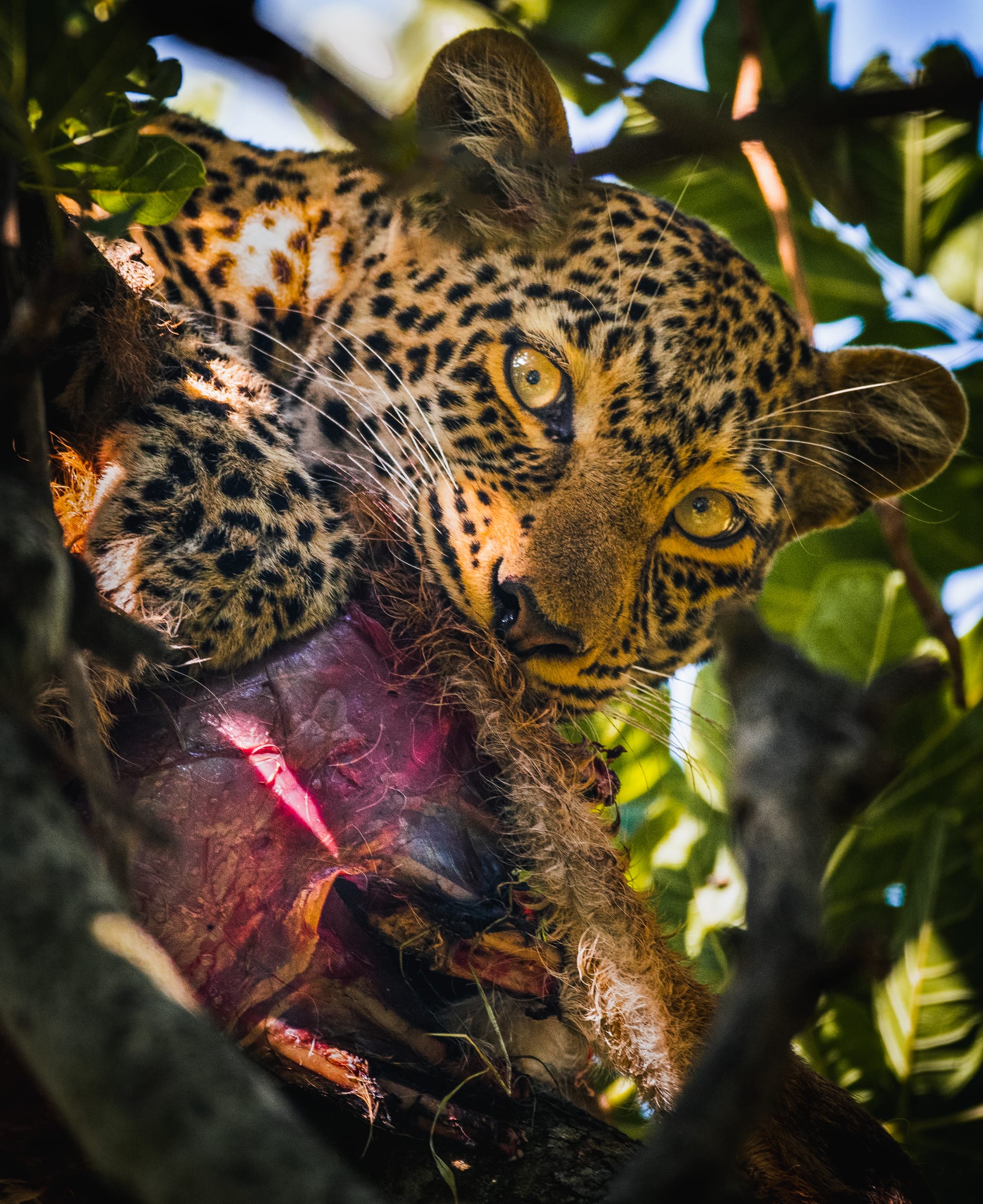
A leopard. Just walking up out of the bush, calm as anything. It looked at the jackal, looked at me (I was maybe fifteen meters away) and then just carried on into the darkness.
Now, leopards are one of the hardest animals to spot on a game drive. People pay thousands of dollars and spend days in the park hoping for a sighting. And here I was, on a Tuesday night errand run, with one walking past me like we were neighbors.
That's what living in the Mara gives you. Not a curated experience. Just life, with leopards in it.
Why I actually built a lodge
My family has been in Kenya's hotel industry for years; my dad has spent most of his career in it. So hospitality was always in the background. But the specific idea for building something in the Mara came from a personal frustration: after fifteen years of family trips, I knew this place better than most tourists ever would, and I still felt like I was only scratching the surface. I wanted to get to know the Maasai people who live here, and to understand the land instead of just photographing it from a Land Cruiser window.
At some point, the idea went from "wouldn't it be cool if" to "let's actually do this." We raised money from friends and family, found land on one of the highest vantage points in the Mara area, and started building.
But I wasn't building a typical safari lodge. I was building the place I wished existed during all those years of short visits. Somewhere you could stay for a week or two without going broke. Somewhere with actual internet. Somewhere that felt like a home base, not a hotel you check out of on day three.
So we put in Starlink. We set up an outdoor workspace. We built dorm beds (proper ones, in these beautiful Manyatta-inspired shared rooms) alongside luxury tented suites for people who want something fancier. The idea was always that you shouldn't have to be wealthy to spend real time in the Mara.
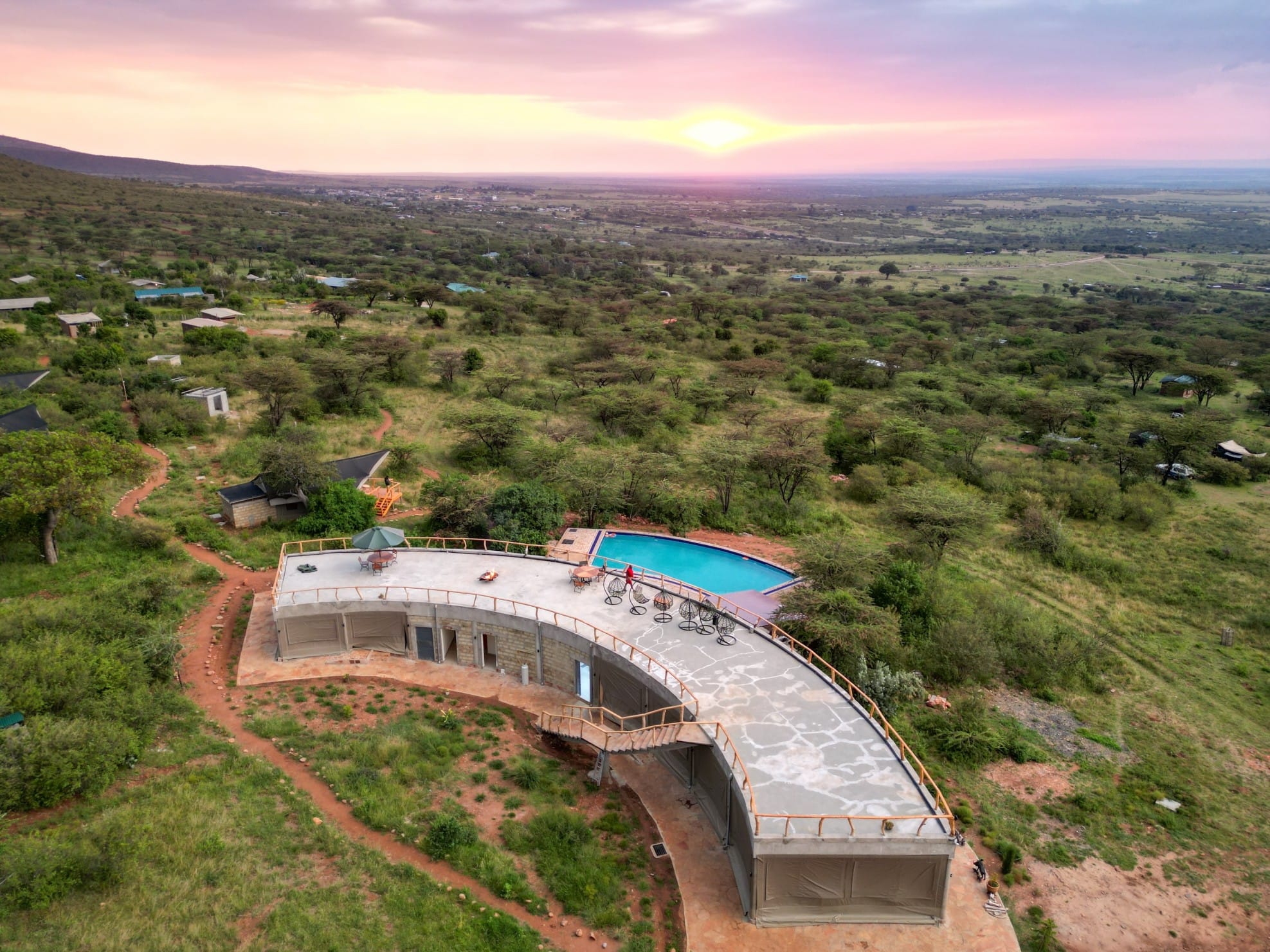
I'm not going to pretend I had a grand business vision mapped out. The honest truth is, I built the place I wanted to use. I'm a developer; I work remotely anyway. I wanted to be able to sit somewhere with a good wifi connection and a view of the savannah and just... be here. For weeks at a time. Get to know the community. Watch the seasons change. Notice things.
What working from here actually looks like
I'll be straight with you because every other article about "remote work safaris" is vague about this part.
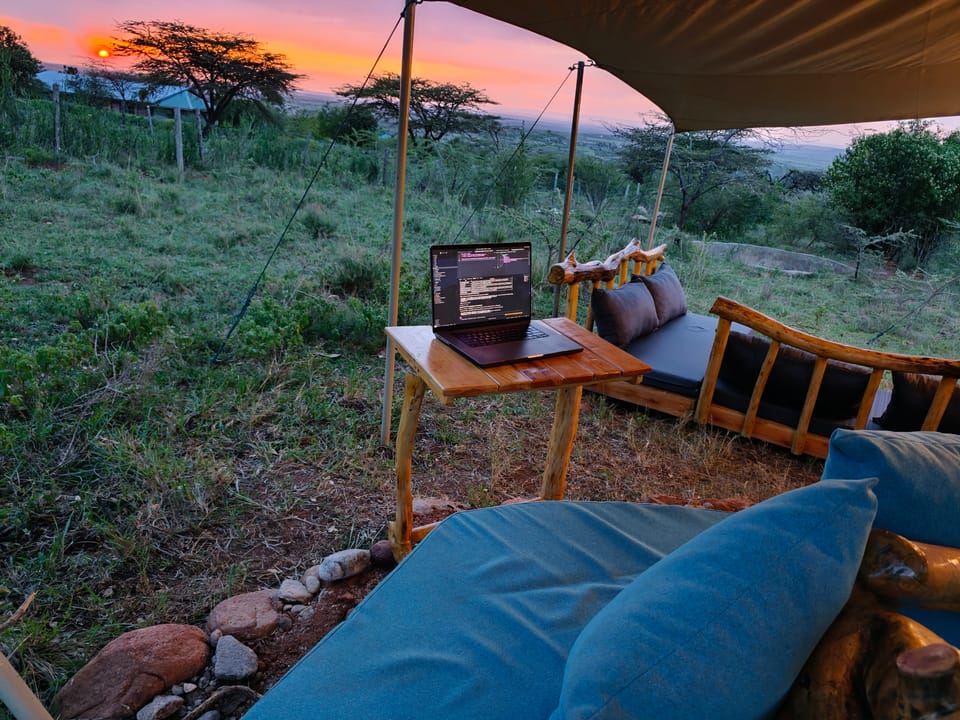
Starlink works. Really well, actually. We typically get 150 to 200 Mbps, a bit less when it's really coming down. It handles video calls, file uploads, code pushes, everything I need as someone who writes software for a living. I've taken client calls during a thunderstorm without a single drop. It's not the kind of connection you'd expect in the middle of the Maasai Mara, but here we are.
A typical day for me when I'm here: I'll sometimes catch a morning game drive if there's something happening in the park. The migration season is wild, and I'm not going to pretend I'm above getting excited about wildebeest crossings even after all these years. Then I'll work through the afternoon. The co-working setup is outdoors, which sounds weird until you're doing it. You're answering emails, you look up, there's a giraffe in the distance. It doesn't get old.
Evenings are for sunsets and dinner and whatever conversations are happening with the guests. Some of the best conversations I've had in years have happened at that table.
You don't have to disconnect (but you can)
I want to be clear about something. Plenty of people come to the Mara to switch off completely. No phone, no email, just the bush. That's beautiful, and I respect it.
But I also know there are people like me. People who love what they do, who don't see work as something they need to escape from. I've been building things on the internet for over ten years and I genuinely enjoy it. The question was never "how do I stop working." It was "where's the most interesting place I can work from."
For me, the answer turned out to be a hilltop in the Maasai Mara where you can hear hyenas at night and watch thunderstorms cross the plains while you're on a call.
The guests who get it
Since we opened, we've had guests who were supposed to stay three nights and ended up staying ten, twelve, fourteen days. When that started happening, I knew it wasn't just me. There's something about this place: the rhythm of it, the space, the fact that you can go on a game drive in the morning and work in the afternoon and watch the sunset from the hill in the evening. It makes people not want to leave.
A Dutch digital nomad named Alieke recently stayed here, worked remotely from one of our tents with Starlink, and wrote about the experience on her blog. She talked about the zebras and hyenas she could hear from her tent at night. That's not marketing. That's just Tuesday around here.
Kenya now has a proper digital-nomad permit too (the Class N, launched in late 2024), and the income requirement has since been cut from $55,000 a year to $24,000, which most articles still get wrong. The infrastructure is catching up to the idea. The Mara is no longer off-limits for people who need to stay connected.
If you're thinking about it
If you've ever had that feeling of visiting somewhere amazing and wishing you could just stay longer, actually get to know the place instead of rushing through it, this is what we built for.
You can stay for three days or three weeks. The wifi works. The coffee is good. The leopards are casual.
And the sunsets — I keep coming back to the sunsets. I've seen hundreds of them from this hilltop. Every single one is different, and every single one makes me stop what I'm doing.
— NJ, co-owner of Mara Hilltop. I live in the Mara and build software from here: the lodge runs on KaribuKit, the hotel platform we make at SimbaStack.